A photograph taken beside the ocean can freeze a person at one particular moment.
The waves roll in, the camera clicks, and viewers see only what happened during that brief afternoon. They cannot see the years of practice that came before it—or the unexpected opportunities still waiting beyond the horizon.
That is especially true of the resurfaced photographs of Australian model Sophia Brennan, who now works under the professional name Sophia Brenn.
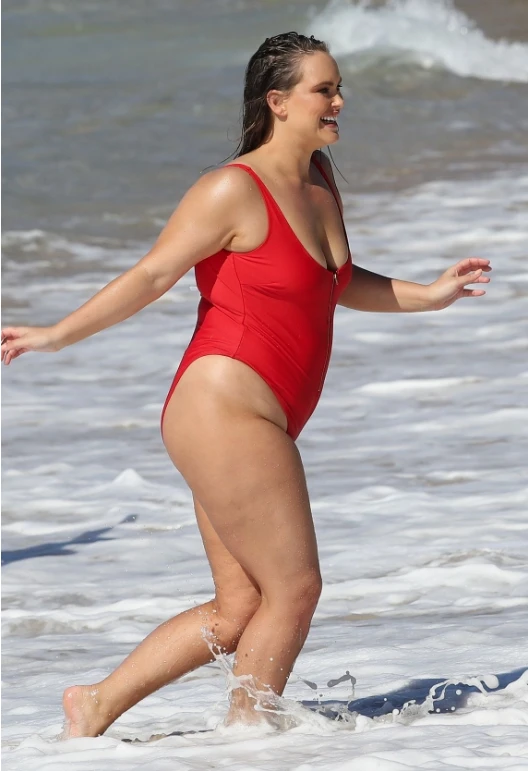
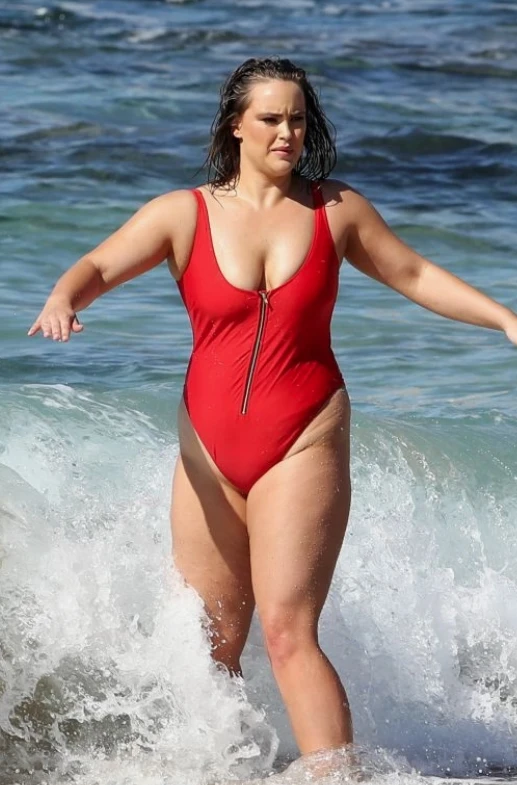
The images show her wearing a red zip-front swimsuit during a shoot along the Sydney shoreline. At the time, she was still building her place in Australia’s fashion industry. In the years that followed, she would leave home for London and appear on major runways in Sydney, Copenhagen, Milan and beyond.
Her story is not simply about being photographed in swimwear. It is about changing direction, learning to value the qualities an industry once treated as limitations, and helping broaden the definition of who belongs on an international runway.
Not a Vacation, but a Day at Work
The original article describes Brennan moving through the Pacific surf as though the photographs captured a quiet personal escape.
Available evidence suggests something more practical.
Archived captions identify the scene as a Sydney swimwear photo shoot from August 2019. Another Australian fashion article from that period featured Brennan modeling beachwear for online retailer The Iconic.
In other words, she was working.
Anyone who has watched a professional photo shoot knows that the finished images rarely reveal everything happening outside the frame. A model may repeatedly enter cold water, hold a pose while waves break around her and wait while photographers adjust their equipment.
What appears carefree may require concentration, timing and patience.
The distinction also protects the photographs from becoming another invitation to evaluate a woman’s appearance.
Brenn was not asking strangers to judge her body during a private day at the beach. She was performing a professional assignment—bringing movement, confidence and personality to clothing being presented for the camera.
Her First Creative Language Was Dance
Long before fashion became the center of her professional life, Brenn trained as a dancer.
Raised in Sydney, she studied hip-hop, jazz and musical theater. She later completed an Advanced Diploma in Performing Arts at ED5International, a well-known Sydney performing-arts school, and returned to the institution as a choreographer.
Dance taught her how to communicate without speaking.
A dancer learns to understand posture, rhythm, balance and the relationship between movement and music. Those same skills can become valuable in modeling, where a small shift in the shoulders or a carefully timed turn may transform a photograph.
Yet dance also introduced Brenn to narrow expectations surrounding appearance.
She has spoken about struggling to find opportunities as a curvier dancer. Rather than abandon creativity altogether, she moved toward choreography and mentoring, discovering that meaningful artistic work could exist on the other side of the stage.
That experience would later shape how she viewed the fashion industry.
She already understood what it felt like to possess ability and discipline while being told—directly or indirectly—that her shape did not match a traditional professional ideal.
A Modeling Competition Opened a New Door
In 2017, Brenn entered an online competition organized by Bella Management, an Australian agency known for representing curve models.
The opportunity placed her within a growing movement that questioned the fashion industry’s historically narrow approach to sizing. Rather than treating models above traditional sample size as exceptions, agencies and designers were slowly beginning to recognize the commercial and creative value of representing a wider range of women.
Brenn brought something distinctive to that changing environment.
She had the physical awareness of a dancer, the creative instincts of a choreographer and firsthand knowledge of what exclusion could feel like. Modeling was not merely a matter of standing in front of a camera. It became another way to challenge assumptions about who deserved to be seen.
The 2019 beach photographs belong to this early chapter.
She was not yet the internationally traveled runway model she would become several years later. She was still gathering experience, learning the rhythms of a new profession and building a portfolio one assignment at a time.
Leaving Sydney for London
Brenn moved to London in late 2022, adopting the shortened professional name Sophia Brenn.
Moving overseas is a significant decision in any career. It means leaving familiar routines, family relationships and professional contacts while attempting to establish a place in an unfamiliar city.
For a model, the uncertainty can be even greater.
Castings may involve long waits followed by quick decisions. Designers work with specific clothing samples, often produced in only one limited size. A talented model may be turned away not because she lacks presence, but because the available garment was never made with her measurements in mind.
Brenn has described attending London Fashion Week castings where agencies were reportedly told that a show had already selected its single curve model. Her account revealed an important limitation of supposedly inclusive casting: representation can still become a box to check rather than a lasting structural change.
Still, she continued attending castings.
That persistence soon led to the most successful runway year of her career.
A Breakthrough at Australian Fashion Week
In 2023, Brenn returned to Sydney and opened the Henne show at Afterpay Australian Fashion Week.
Opening a runway presentation is a position of trust. The first model establishes the mood, introduces the collection and gives the audience its first impression of the designer’s creative direction.
Brenn appeared in a long coat and sheer dress, walking at the front of a mainstream fashion presentation rather than being separated into a specially labeled “inclusive” event.
She later said the opportunity felt authentic rather than symbolic. The designers had produced an additional sample in her size, fitted the garment and selected it as the opening look because they believed it worked.
That practical detail mattered.
Meaningful inclusion does not begin when a model reaches the runway. It begins much earlier, when designers decide which sizes to manufacture, casting teams consider a broad selection of professionals and clothes are prepared for more than one narrow body type.
Brenn ultimately walked in seven shows during Australian Fashion Week that year. Her presence was part of a wider, though still incomplete, movement toward more representative casting.
From Copenhagen to Milan
Her 2023 season continued beyond Australia.
Brenn made her London Fashion Week debut with Brazilian-born designer Karoline Vitto, whose work frequently explores curves and the relationship between clothing and the body. She later appeared for Ganni during Copenhagen Fashion Week.
Then came Milan.
At Karoline Vitto’s Spring 2024 presentation, produced with support from Dolce & Gabbana, Ashley Graham opened the show and Brenn followed immediately behind her.
For Brenn, the moment carried special meaning. She had long admired Graham and fellow model Paloma Elsesser, both of whom helped create opportunities for models who did not conform to the industry’s traditional sample sizes. Sharing a runway with women who had influenced her made the achievement feel almost unbelievable.
There is a generational pattern in nearly every creative field.
One person accepts the difficulty of being among the first. Others see that example and begin imagining a place for themselves. Eventually, the newcomers become references for the people who follow them.
Brenn’s career now forms part of that continuing chain.
Why Clothing Samples Matter
Discussions about representation in fashion can sometimes sound abstract. In practice, one of the largest obstacles is surprisingly simple: the clothes must exist.
Most runway samples have historically been produced in very small sizes. Even when a casting director wants to hire a broader range of models, there may be nothing available for them to wear.
Brenn has emphasized that size diversity cannot be added at the last minute. Designers need to plan for it while collections are being developed and produce samples suited to the professionals they hope to cast.
This does not mean every model must appear in every show.
It means talent should not be excluded automatically because an industry has continued following production habits established generations ago.
Her current professional profile reflects how far she has traveled. Models.com lists Brenn as an Australian model based in London, represented by agencies in several international markets. Her credited work includes editorials and numerous runway appearances.
The Discipline Behind the Confidence
The language surrounding modeling often emphasizes confidence, as though it were something a person either possesses or does not.
Brenn’s journey suggests a more useful interpretation.
Confidence can be built through repetition.
It grows during dance rehearsals when a difficult sequence finally becomes natural. It develops through castings that end in rejection and the decision to attend another one the following morning. It becomes stronger when a performer learns that being different from the expected standard does not make her less capable.
The woman walking through the Sydney surf in 2019 could not have known precisely what lay ahead.
She could not see the Henne runway, her London debut or the moment she would follow Ashley Graham onto a Milan stage.
She could only complete the assignment in front of her.
Many careers are built in exactly that fashion—not through one grand decision, but through ordinary days of preparation that eventually lead somewhere extraordinary.
More Than a “Rising Star”
Calling Brenn a rising star makes an appealing headline, but it understates the years behind her success.
She was a dancer before she became a model. She taught and choreographed before international designers knew her name. She began modeling in Australia, moved across the world and continued through an industry that frequently claimed to value diversity without always providing the clothing or opportunities needed to support it.
Her accomplishments were not produced by one viral photograph.
They grew from training, adaptability and a willingness to enter spaces where women with her proportions had historically been underrepresented.
That makes her story especially meaningful for readers who have changed careers later than expected or discovered that an early disappointment could lead toward a more suitable path.
The dance world did not offer Brenn every opportunity she hoped to find. Yet the knowledge gained there became one of her strengths in fashion.
Very little learning is truly wasted.
A Photograph Before Everything Changed
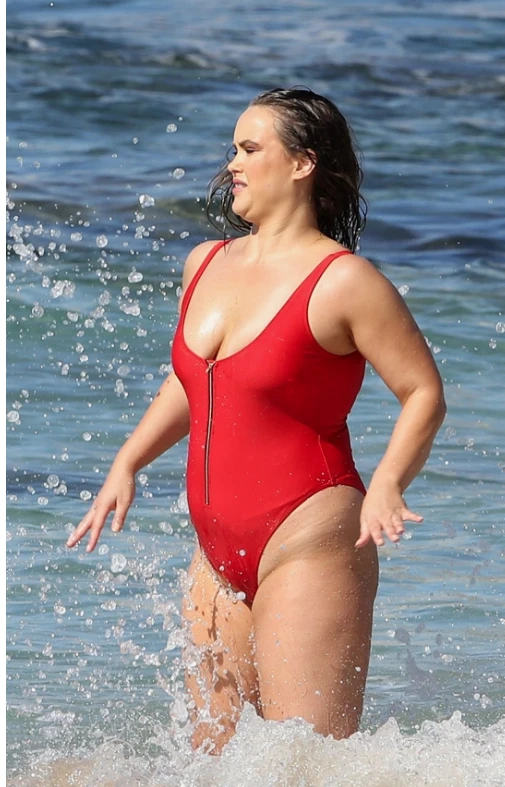
The final portrait included by the source appears to come from an earlier period of Brenn’s life.
Seen beside the runway achievements that followed, it emphasizes how gradually a public career can develop.
There is no international fashion week in the background. No designer name appears beside her. It is simply the face of a young creative person whose professional direction had not yet become clear.
Years later, she would be photographed in clothing created for some of the industry’s most visible stages.
That transformation did not require her to become an entirely different person. It required the fashion world to begin recognizing qualities that were already there.
The Larger Meaning of Her Journey
Fashion may seem distant from everyday life, but the questions surrounding Brenn’s career are familiar.
Who is considered suitable before being given a chance?
How many talented people are overlooked because the available system was designed around someone else?
And what might happen when institutions make practical room for a broader group of participants?
Brenn does not argue that progress is complete. Runway casting remains inconsistent, and a few visible appearances cannot erase decades of restricted sizing.
Yet every properly planned opportunity establishes another example.
A mainstream designer can create more than one sample size. A curve model can open a show rather than appear as an afterthought. A young dancer who once struggled to fit one industry’s expectations can build an international career in another.

Those examples make the next decision easier.
The Woman Beyond the Beach Photograph
The resurfaced Sydney images capture energy, movement and a bright red swimsuit against the blue Pacific.
They do not capture the entire woman.
They do not show the dancer learning choreography, the teacher encouraging younger performers, the model waiting outside a London casting or the professional preparing to step onto a Milan runway.
A photograph rarely reveals the labor behind a life.
Sophia Brenn’s real story begins where the image ends—with the years of work that carried her from a Sydney beach to some of fashion’s most important international stages.
Her journey offers a warm reminder that the qualities once treated as obstacles can become part of what makes a person memorable.
Sometimes the future does not require changing who we are.
It requires finding—or helping create—a world with enough imagination to recognize our value.
Had you heard of Sophia Brenn before seeing these photographs, or is her international fashion journey new to you?