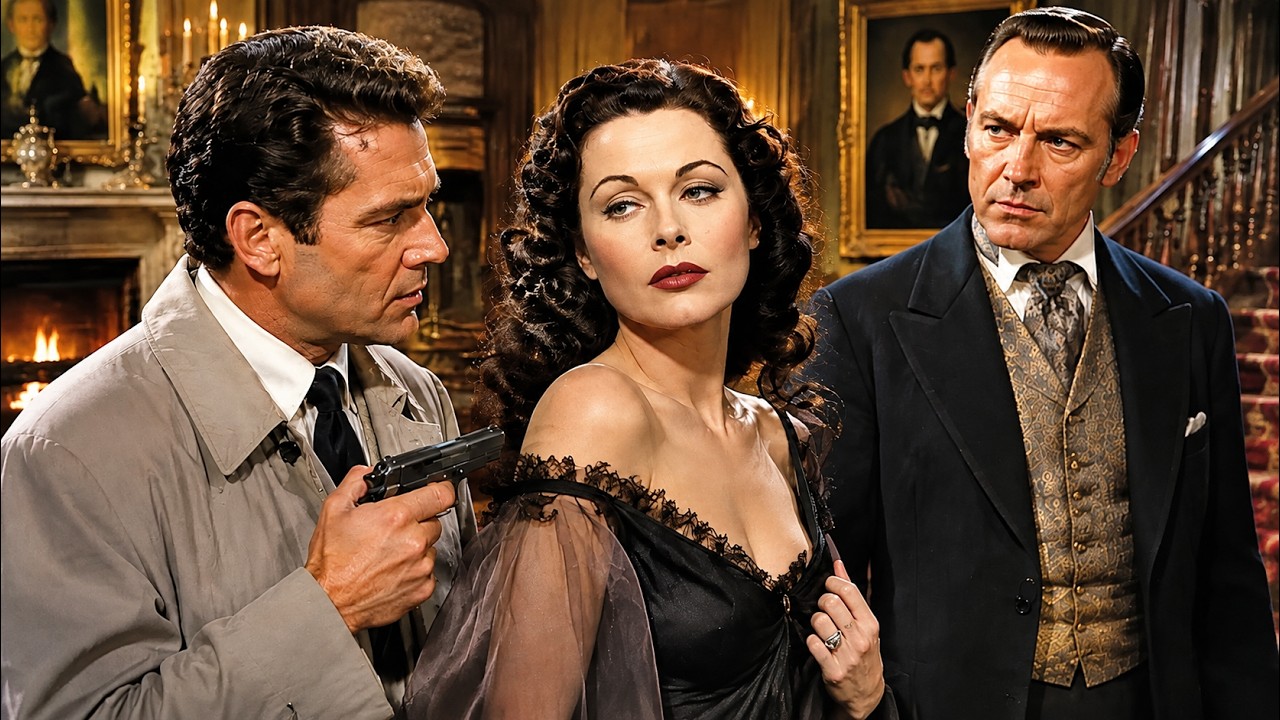
Hedy Lamarr’s Forgotten Noir Still Feels Mysterious in the Angkor Forest
The forest was quiet after the rain.
I had been walking along one of the less crowded paths near Angkor Wat when the sound of an old movie came from a small screen nearby. The picture was black and white, the voices carried that unmistakable rhythm of classic Hollywood, and for a moment the ancient Cambodian forest seemed very far away from Los Angeles in the 1940s.
Then Hedy Lamarr appeared.
It was one of those moments when the past seems to arrive without announcing itself.
Lamarr’s face on the screen looked almost impossibly composed. The expression was calm, but there was something underneath it—a suggestion that the character knew more than she was saying.
That quality is part of what makes classic film noir so enduring.
The characters rarely explain everything.
A glance can matter.
A pause can matter.
Sometimes the silence between two lines tells you more than the dialogue.
Watching Strange Woman in that setting made me think about how differently movies are experienced today. Modern films often move quickly from one event to the next. Older Hollywood pictures could allow a character to simply sit, look across a room, or walk through a doorway while the audience wondered what was happening inside her mind.
Lamarr was particularly fascinating because audiences often remembered her beauty before they remembered the complexity of her career.
She was a movie star, but she was also an inventor and a remarkably curious person. Her story outside Hollywood is almost as interesting as the characters she played.
That thought stayed with me as I looked away from the screen toward the forest.
The trees around Angkor were enormous. Their roots had pushed against ancient stones for generations. Moss covered surfaces that had once been carefully carved. Sunlight moved between the branches in narrow patches.
The forest had its own version of mystery.
Nothing needed to be explained.
A shadow moved across the path.
Leaves shifted overhead.
A distant bird called and then stopped.
It was easy to understand why noir filmmakers loved atmosphere. Mystery doesn’t always require darkness. Sometimes it only requires uncertainty.
Strange Woman, released in 1946, belongs to a period when Hollywood was filled with stories about ambition, relationships, secrets and difficult choices.
Watching it decades later, I was struck by how familiar some of those emotions still feel.
People still want to be understood.
They still make decisions they later reconsider.
They still wonder whether success will make them happier.
Technology has changed almost everything about filmmaking, but those questions haven’t changed much.
When the movie ended, the screen went dark.
The forest remained.
For a few seconds I simply stood there listening to the insects.
I thought about Lamarr and the strange way time treats famous people. Some become permanently associated with one image. Others gradually disappear from everyday conversation, even though their work remains available for anyone willing to look.
Maybe that’s why old films are worth revisiting.
They don’t simply show us another era.
They give forgotten performers another opportunity to be seen.
And sometimes, in the right place, a movie made eighty years ago can feel surprisingly close.
VIDEO PLACEMENT: Insert an authorized full movie, trailer, or licensed video here.
IMAGE PLACEMENT: Insert the main classic-Hollywood/Angkor forest image here after the fifth paragraph.
Image Alt Text
Hedy Lamarr-inspired classic Hollywood portrait beside the atmospheric Angkor Wat forest and ancient stone ruins.
Caption
Some classic films don’t disappear—they simply wait for a new generation to discover them.
Thumbnail Description
Elegant black-and-white-inspired portrait of a 1940s Hollywood actress against a lush Angkor Wat forest, with soft mist, ancient stone ruins and subtle film-noir lighting. Sophisticated rather than sensational.
Four Top Story Captions
A Forgotten Hollywood Mood: Hedy Lamarr’s classic screen presence still feels striking decades later.
When Noir Meets Angkor: An old Hollywood film creates an unexpected moment of reflection in an ancient forest.
The Star Behind the Mystery: Revisiting Hedy Lamarr through the atmosphere of classic cinema.
Some Films Wait to Be Found: Why overlooked movies from Hollywood’s golden era can still feel remarkably alive.
TL;DR
A fictionalized walk through the Angkor forest inspires a reflection on Hedy Lamarr, Strange Woman and the enduring atmosphere of classic film noir.