There is always something happening if you stop long enough to notice it. Leaves move high above the path. A bird calls from somewhere beyond the trees. Visitors walk past, their voices fading as quickly as they arrived. Sunlight slips through the branches and lands on the old stone in small, changing patches.
It is a setting built around patience.
Now imagine the opening rhythm of Jennifer Lopez’s “Let’s Get Loud” traveling through that quiet.
The contrast is immediate.
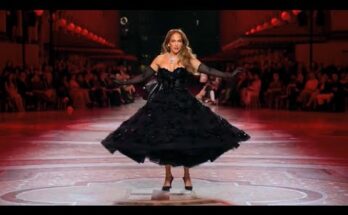
Lopez’s Dolce&Gabbana Alta Moda performance in Taormina was designed around movement, music and elaborate craftsmanship. The Italian fashion house described the 2026 celebration as a four-act performance created specifically for Lopez, with custom looks accompanying different parts of the show.
“Let’s Get Loud” belongs naturally to that kind of environment. It is energetic, familiar and made for movement.
But place that energy in the Angkor forest, and the feeling changes.
There is no large stage here.
No wall of lights.
No sea stretching behind the performer.
Instead, there are enormous trees and ancient stone.
Imagine standing a short distance away as the music begins. The first thing you might notice is not the clothing or even the performance. It would be the way the sound changes the atmosphere.
A quiet forest suddenly has a rhythm.
The branches remain still.
The stone remains still.
But the person in the middle of the scene is moving.
That contrast makes the imagined moment feel almost cinematic.
Modern music surrounded by centuries-old architecture.
A contemporary fashion look against deep green leaves.
A familiar American entertainer placed inside a landscape that feels very far from the world of red carpets and concert arenas.
[VIDEO EMBED HERE]
For American audiences, that difference is part of the appeal.
Most celebrity performances reach us through a screen. We see carefully positioned cameras, bright lights, choreographed movement and polished production.
The forest offers none of those guarantees.
The light changes naturally.
The wind moves clothing differently from one moment to the next.
A shadow can cross the frame without warning.
Instead of controlling every detail, the environment becomes part of the scene.
That makes the imagined photograph feel less like a publicity image and more like a moment someone happened to witness.
[IMAGE PLACEHOLDER HERE]
There is another connection worth noticing.
Both haute couture and historic architecture depend on craftsmanship.
Dolce&Gabbana’s Alta Moda presentation places enormous attention on handwork, materials and detailed construction. Angkor’s architecture represents a completely different tradition and period, but it also reflects generations of human labor and artistic skill.
The materials are different.
The techniques are different.
The centuries are different.
But the instinct is familiar: create something carefully enough that people will stop and look.
That is perhaps the most interesting way to imagine Lopez’s performance in this setting.
Not as a replacement for the original Taormina event.
Not as a claim that she stood beneath these trees.
But as a visual conversation between two very different kinds of beauty.
The music says to move.
The forest says to slow down.
For a few imagined minutes, both can exist together.
Then the song ends.
The forest returns to its ordinary sounds.
A leaf moves overhead.
Someone walks along the path.
The sunlight shifts across the stone.
And the performance becomes a memory rather than a spectacle.
That final quiet might be the part you remember longest.