A day at the beach should be one of life’s simplest pleasures.
There is the sound of the surf, the warmth of the sun and the welcome feeling of leaving ordinary responsibilities behind for a few hours. Yet when the person walking along the shoreline happens to be Goldie Hawn, even an unremarkable vacation moment can become a public conversation.
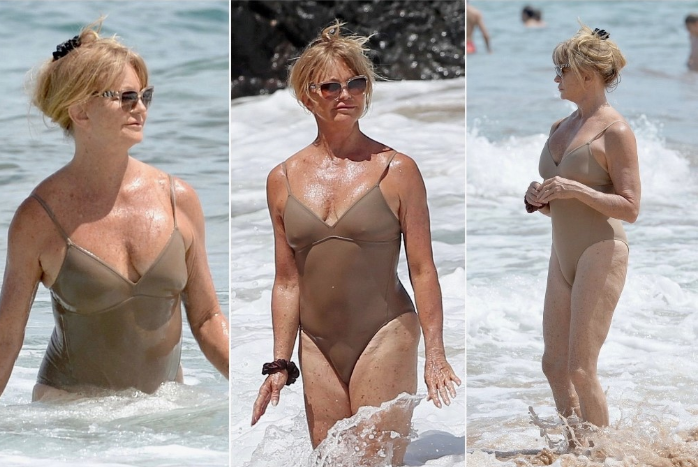
The photographs recently circulating online show Hawn wearing sunglasses and a simple one-piece swimsuit as she steps through the waves. Some online commenters responded warmly, while others offered unnecessary opinions about her appearance.
The more meaningful story, however, is not what a celebrated actress chose to wear near the water. It is how a woman who has lived in the public eye for nearly six decades continues to move through life on her own terms.
A Photograph That Says More About Us Than About Her
Celebrity photographs often invite strangers to make judgments they would never offer face-to-face.
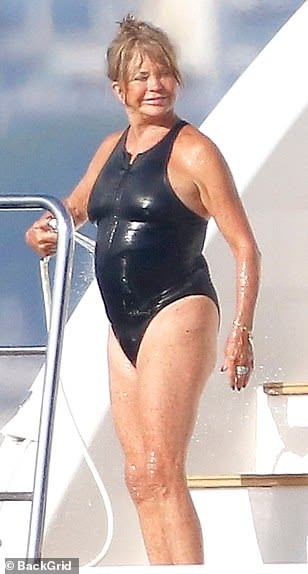
A single image may be examined as though it reveals a person’s health, happiness or private state of mind. In reality, it captures only a fraction of a second. These vacation pictures show little more than Hawn enjoying the ocean in ordinary beachwear. The original source does not reliably establish when or where they were taken.
The conflicting online reactions reveal something broader about the expectations placed on older women, particularly those who have spent their lives in entertainment.
A man may grow older on screen and be described as distinguished. A woman of the same generation is often expected to explain, disguise or apologize for the normal passage of time.
Hawn has never appeared especially interested in doing that.
Her appeal has always come from a lively combination of humor, intelligence and independence. Long before public conversations about “authenticity” became fashionable, she built a career around being unmistakably herself.

The Dancer Who Made America Laugh
Goldie Hawn’s professional life began with movement rather than movie dialogue.
Born in Washington, D.C., in 1945, she studied ballet as a child and later worked as a dancer and dance instructor. Her early television work included the short-lived sitcom Good Morning World, but her national breakthrough came as a regular performer on Rowan & Martin’s Laugh-In beginning in 1968.
For viewers who remember those years, Laugh-In was unlike nearly anything else on television.
The program moved at a cheerful, almost breathless pace. Political jokes, colorful costumes, one-line gags and surprise celebrity appearances arrived one after another. Hawn’s bright smile and high-spirited comic timing made her one of its most recognizable performers.
She was sometimes presented as a carefree “dumb blonde,” but Hawn understood that playing a comic character did not define the woman performing it. When critics questioned whether the role conflicted with the women’s liberation movement, she responded that liberation came from within.
That distinction became important throughout her career.
Hawn could appear lighthearted without being lightweight. She could play confusion while remaining completely in command of the joke. Audiences laughed because she understood exactly what she was doing.

An Oscar Arrived Almost Overnight
Cactus Flower was not Hawn’s first screen appearance, as some brief biographies have suggested, but it was her first major movie role.
Playing Toni Simmons opposite Walter Matthau and Ingrid Bergman, she brought warmth and vulnerability to a sophisticated romantic comedy. The performance earned her the Academy Award for Best Supporting Actress at the 1970 ceremony.
She was only 24 when she won.
The recognition could easily have limited her to variations of the same charming character. Instead, Hawn gradually proved that her comic gifts could carry an entire film.
She became one of the most dependable stars of American comedy through pictures including Foul Play, Seems Like Old Times, Overboard, Death Becomes Her and The First Wives Club. Her résumé also included more dramatic and adventurous projects such as Steven Spielberg’s The Sugarland Express.
Each role preserved a familiar quality: the sense that Hawn’s characters might be surprised by life, but they were rarely defeated by it.
Private Benjamin Changed the Rules
One of the most important films of Hawn’s career arrived in 1980.
In Private Benjamin, she played a sheltered young widow who joins the Army after being misled about what military life will involve. The character begins the story unprepared and dependent, then gradually develops a stronger understanding of herself.
Hawn did more than star in the film. She also helped produce it at a time when actresses had fewer opportunities to guide major studio projects behind the camera. The performance earned her an Academy Award nomination for Best Actress.
For many women who saw the movie during its original release, its lasting appeal went beyond the comedy.
The story suggested that beginning again was possible—even after disappointment, even when others underestimated you and even when the new path looked nothing like the life you had planned.
That message feels just as relevant decades later.
Refusing Hollywood’s Expiration Date
Hawn has spoken openly about the limited roles traditionally offered to women as they grow older.
She has not pretended that age discrimination disappeared simply because she achieved fame. During a 2017 interview, she acknowledged the entertainment industry’s tendency to treat actresses as though they have a “shelf life.” Her response was not to deny the problem, but to avoid allowing anger to control her choices.
“Anger doesn’t get you anywhere,” she said.
That outlook should not be mistaken for passivity.
When the industry did not provide enough interesting opportunities, Hawn produced projects herself. When acting no longer felt like the center of her life, she stepped away. Between 2002 and 2017, she took almost no screen roles and devoted more attention to family, learning and philanthropic work.
Her decision challenged one of Hollywood’s oldest assumptions: that a successful performer must remain visible at all costs.
Hawn appeared to understand that a meaningful life could continue beyond premieres, reviews and box-office reports.
A Partnership That Outlasted Hollywood Expectations
Hawn’s life with Kurt Russell has also unfolded outside the usual celebrity pattern.
They first met while working on a Disney movie in 1968 but did not become a couple until they reconnected approximately 15 years later. Their relationship has now lasted more than four decades. They share a son, actor Wyatt Russell, and built a blended family that includes Hawn’s children Kate and Oliver Hudson and Russell’s son Boston.
Hawn and Russell have never felt compelled to marry simply to satisfy public expectations.
She has described their partnership as a continuing decision to remain committed rather than a relationship defined by a legal document. Their endurance has made them one of Hollywood’s most familiar long-term couples.
Older readers may appreciate the practical wisdom in that outlook.
There is no single arrangement that guarantees lasting affection. What matters is the daily work of friendship, patience, shared history and the willingness to keep choosing one another.
A Second Career Devoted to Children
The most significant chapter of Hawn’s later life may have little to do with acting.
In 2003, she established the Goldie Hawn Foundation and developed MindUP, an educational program intended to help young people understand their emotions, improve concentration and build resilience through neuroscience, social-emotional learning and mindful-awareness practices.
According to the organization, MindUP has reached approximately seven million children and 275,000 educators around the world.
That work reveals a side of Hawn that casual moviegoers may not know.
The comic actress who once made millions laugh became deeply involved in helping children manage stress, practice empathy and develop emotional skills that many adults were never taught in school.
In 2026, at age 80, she carried that mission into children’s literature with The After-School Kindness Crew: Pooch on the Loose, co-written with Lin Oliver. The story incorporates ideas from MindUP while emphasizing humor, friendship and care for others.
The project feels like a natural extension of her career. Hawn has always believed that learning and laughter can exist together.
Why the Beach Pictures Matter—and Why They Do Not
The photographs matter because they started a conversation about age, visibility and the freedom to live without constant self-consciousness.
At the same time, they should not matter nearly as much as some online reactions suggest.
A woman does not owe the public a particular appearance before entering the ocean. Growing older is not a personal failure, and a vacation is not an audition.
Hawn once described aging as evidence that a person remains fortunate enough to be alive. That perspective is far more valuable than any stranger’s judgment about a swimsuit photograph.
Her career offers a similar lesson.
She moved from dancer to television comedian, from Oscar-winning actress to producer, from mother and grandmother to international advocate for children’s emotional well-being. None of those chapters erased the ones before them.
They simply expanded the story.
Still Goldie After All These Years
For viewers who first saw her giggling on Laugh-In, Goldie Hawn may forever carry the glow of late-1960s television.
Others remember the determined heroine of Private Benjamin, the screwball romance of Overboard or the joyful friendship at the center of The First Wives Club.
Younger generations may know her as Kate Hudson’s mother, Kurt Russell’s longtime partner or the founder of a program used in schools around the world.
Each version is true, but none is complete by itself.
The vacation photographs capture only one passing afternoon. They cannot explain the ambition required to survive Hollywood, the courage needed to step away from it or the compassion behind more than two decades of work for children.
What they can offer is a simple reminder.
At 80, Goldie Hawn does not need to prove that time has stood still. Her real achievement is that she has continued moving forward—with curiosity, humor and an enduring belief that life should be met with gratitude rather than fear.
Goldie Hawn on Her Crazy Alien Experience, Missing Her Oscars Win & Sketch with Harlem Globetrotters